
What is LARP ?
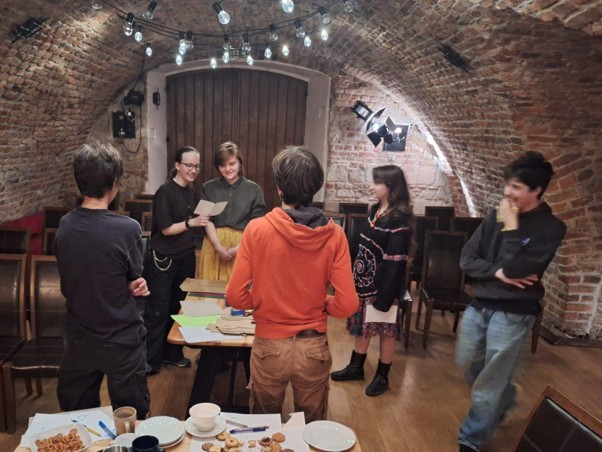
Live Action Role-Playing (larp) is an improvised form of role-play in which participants physically embody characters and act within a shared fictional world. It is a narrative-based experience where the story unfolds in real time through interaction, movement, and decision-making.
For me, and in the work we do within Nausika, larp sits somewhere beautifully in between a game, theatre, and participatory art. It borrows from all of these forms, but it is not fully any of them. There is no audience – only participants. Everyone present co-creates the experience. You don’t watch the story, you step into it.
What makes larp unique is that it happens through the body. You don’t just imagine what your character feels – you walk, speak, react, and relate as them. And somehow, through this process, something shifts. A fictional situation becomes a space where very real emotions, reflections, and insights can emerge.
Larps can take many forms. Sometimes they are intimate and quiet, focusing on small human stories. Other times they are large-scale, epic, and full of dramatic tension. They can mirror the world we live in, offer a glimpse into the future, or take us to completely fictional realities. But at their core, they always ask the same question: “what if?”
What if you were someone else, in a different situation, making different choices?
In larps, you can become almost anything – a medieval leader, a climate activist, a neighbour in a small town, an abstract emotion, or even a system or idea. This openness creates space to explore perspectives we don’t usually have access to. Through symbols and metaphors, we can approach topics that might otherwise feel too complex, too distant, or too difficult to talk about directly.
There is no single way to larp. Different traditions bring different styles, rhythms, and expectations. Some experiences aim for deep immersion and emotional intensity, while others are more structured, game-like, or playful. In our work in Nausika, we often move between these approaches, sometimes creating highly immersive experiences, other times more gamified or workshop-based larps, depending on what serves the group best.
Because of this flexibility, larp can serve many different purposes. It can be a space for creativity and artistic expression. It can be a tool for connection and community building. It can be a playground for joy and experimentation, but also a space for self-reflection, where people explore their emotions, reactions, and ways of being.
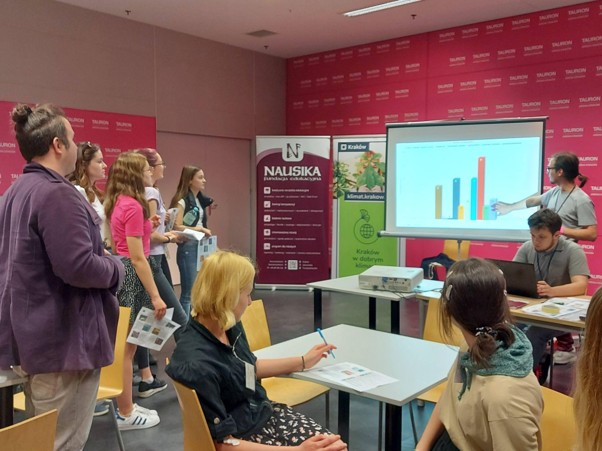
What we have found in Nausika is that larp becomes particularly powerful when used in educational contexts. It allows participants not only to talk about topics such as climate change, social dynamics, or identity, but to experience them from within. This makes learning more personal, embodied, and often more memorable.
That’s why larp is increasingly used with different age groups and in different environments – from schools and youth exchanges to professional training and community work. It can be adapted to children, young people, and adults, and shaped to fit both simple and complex learning goals.
In some of our projects, we also connect larp to broader frameworks such as GreenComp, exploring sustainability competencies through experience rather than theory. When participants take on roles within systems, make decisions, and face their consequences, they begin to understand complexity, interdependence, and responsibility in a very tangible way.
In our work, we have developed larps such as “Climate Perspectives”, “Time to Land”, “Pig Grove”, “Tree of Life”, and “Ceremony of Hope”, all exploring sustainability and climate-related challenges – each in its own way and on different levels of immersion. Some focus on understanding systemic mechanisms, such as economic dynamics, others on navigating diverse perspectives and conflicting interests, and others still on reflection, emotions, and personal connection to the topic.
At the end of the day, larp is a shared agreement to imagine together, but also to take that imagination seriously for a moment. It creates a temporary space where people can explore, experiment, and experience something meaningful, through their bodies, their emotions, and their relationships with others.
And maybe that’s why it stays with people long after the game is over.
References:
Bowman, S. L. (2014). Educational Live Action Role-playing Games: A Secondary Literature Review. The Wyrd Con Companion Book 3, 112–131.
Johansson, K., Breejon Robinson, R., Bowman, S. L., Fey, J., Márquez Segura, E., Waern, A., & Isbister, K. (2024). Why Larp?! A Synthesis Paper on Live Action Roleplay in Relation to HCI Research and Practice. arXiv:2405.08526.