From Knowing to Acting: A Practical Guide to Sustainability Education
What does it actually mean to teach sustainability?
At first, the answer might seem straightforward. Talking about climate change. Explaining recycling. Discussing biodiversity, pollution or renewable energy. Encouraginge young people to make environmentally responsible choices.
But knowledge alone rarely changes the world.
A young person can understand perfectly well that fast fashion creates enormous environmental costs and still buy another €8 T-shirt. They can know that climate change is accelerating and simultaneously feel that the problem is simply too large for them to influence. Sustainability education therefore faces a bigger challenge: how do we move from knowing about sustainability to thinking, imagining and acting sustainably?
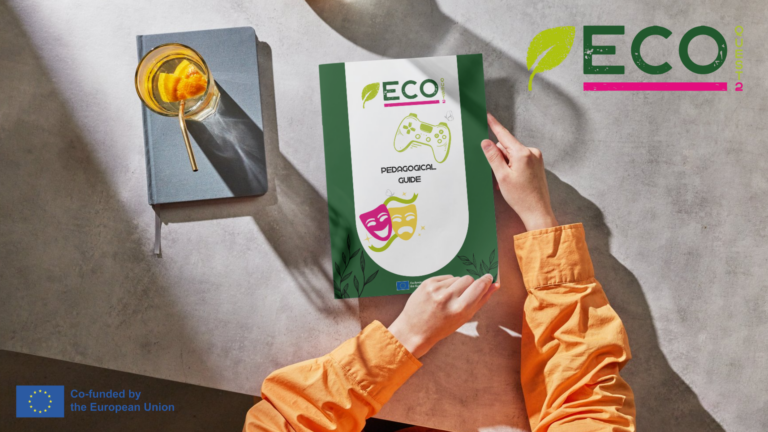
This is the question at the heart of the new EcoQuest 2 Pedagogical Guide.
Sustainability is more than a topic
The guide introduces educators and youth workers to GreenComp, the European Sustainability Competence Framework, and translates its sometimes rather grand European terminology into something that can actually be used in a classroom, youth centre, workshop or community project.
GreenComp approaches sustainability through four interconnected areas: embodying sustainability values, embracing complexity in sustainability, envisioning sustainable futures and acting for sustainability. Together, these areas contain twelve competences ranging from critical and systems thinking to futures literacy, collective action and political agency.
That distinction matters because the guide is not simply about teaching about sustainability. It is about teaching for sustainability.
Instead of asking only, “Do young people understand the environmental problem?”, educators are encouraged to go further. Can they recognise greenwashing? Can they see connections between consumption, economics, social justice and environmental impacts? Can they question how a problem is presented to them? Can they imagine alternatives? And, perhaps most importantly, do they feel capable of doing something about it?
From greenwashing to imagining 2050
One of the strengths of the guide is that it does not leave these ideas floating around in the comfortable universe of educational theory.
It uses situations young people actually encounter. Fast fashion, carbon offsets, corporate environmental claims and “green” advertising become opportunities to practise critical thinking. Learners are encouraged to look beyond the label and ask who benefits, what information is missing and whether a supposedly sustainable solution actually addresses the wider system behind the problem.
But sustainability education cannot consist entirely of explaining how badly humanity has managed things so far. That is hardly a motivational masterpiece.The guide therefore gives equal importance to futures literacy and exploratory thinking. Young people can be invited to imagine what cities, food systems, mobility or everyday life could look like in 2050. Instead of treating the future as something waiting to happen to them, they begin to understand it as something shaped by decisions being made today.
A practical resource for educators and youth workers
The guide is particularly useful because it was designed with different learning environments in mind. GreenComp can be applied in formal education, but also in youth work, international exchanges, workshops, camps, community initiatives and everyday informal learning. It places strong emphasis on non-formal and experiential education, participatory methods, project-based learning and inclusive approaches.
Educators do not need to redesign their entire programme overnight either. The guide proposes a simple process: select one or two relevant GreenComp competences, define the desired learning outcomes, choose an appropriate method, include space for reflection, and then evaluate and adapt the activity.
A workshop about food waste, for example, could combine systems thinking with individual initiative. A role-play could explore political agency. A community project could develop collective action. Scenario-building can strengthen futures literacy. Debates, simulations, storytelling, outdoor activities and creative workshops can all become tools for sustainability learning.The publication also points educators towards existing European resources, toolkits, case studies and ready-to-use activities, making it useful both as an introduction to GreenComp and as a starting point for developing new educational programmes.
Part of the EcoQuest 2 journey
The Pedagogical Guide was developed as part of the EcoQuest 2 project and provides the educational foundation for the project's wider learning experience. Its principles support the development of EcoQuest 2's innovative educational tools, including a video game and a Live Action Role-Playing (LARP) game, connecting sustainability education with interactive, experiential and game-based learning.
Ultimately, the guide does not offer educators a rigid script. It offers something considerably more useful: a pathway from values to understanding, from understanding to imagination, and from imagination to action.
Because sustainability education should not only prepare young people to understand the future they may inherit. It should give them the confidence, skills and space to participate in creating a different one.